Walk Into the American Revolution in New York City
New York’s Revolutionary history is less celebrated than Boston’s, less obvious than Philadelphia’s, and more interesting than either. The stories you’ll encounter on these walking tours, day trips, and museum visits are as messy, urban, and surprising as NYC itself.
A statue of the king melted down to make musket balls. A peace negotiation that could have ended the Revolution but fell apart after three hours. A rearguard action in Brooklyn that saved the cause of American independence.
From the summer of 1776 until 1783 (two years after the British surrender at Yorktown), New York was occupied, contested, burned, and rebuilt — and the most important historical sites are still here. Some you’ll find tucked between glass towers and brokerage firms, or marked by plaques you might walk past without noticing. But that’s part of what makes them worth finding. New York’s Revolutionary landscape rewards the curious.
This guide covers the essential sites of the Lower Manhattan Revolutionary Trail, plus some outer-borough locales and stories most visitors never encounter. Taken together, they tell a version of history that’s more engaging than the one that made it into your high school textbook.
The Lower Manhattan Revolutionary Trail
This self-guided walking route is approximately 1 to 1.5 miles. Allow 90 minutes for the walk alone; a full day if you’re planning to visit the museums at Fraunces Tavern and Federal Hall.
Battery Park: 32,000 Troops in New York Harbor
Begin in Battery Park, at the southern tip of Manhattan. Named for the artillery batteries that were positioned here in the 17th and 18th centuries, these days the park is popular for lunch breaks in the open air with views of the harbor and the Statue of Liberty. Tourists are there for ferry rides to three famous islands (Staten, Liberty, and Ellis).
Most visitors are unaware of what happened here. Stand at the water’s edge, look south. and imagine the day, in August 1776, when the British fleet sailed into the harbor — 32,000 soldiers, the largest expeditionary force Britain had ever assembled — as New Yorkers watched from this shore and realized that they were going to lose their city.
Bowling Green: Where New Yorkers Said, “Down With the King”
A two-minute walk north, to the southern end of Broadway, brings you to New York City’s oldest public park, Bowling Green, a small oval of grass enclosed by an iron fence. Take a good look at that fence. It’s one of the few places in New York where you can see a direct, unrestored physical trace of a Revolutionary-era event
On July 9, 1776, a few days after the Declaration of Independence was signed in Philadelphia, a copy of the document was read aloud to Washington’s troops assembled in Lower Manhattan. That evening, a crowd of citizens galvanized by the Declaration gathered at Bowling Green and pulled down the gilded lead statue of King George III. The statue was carted to Connecticut, melted down, and recast as approximately 42,000 musket balls for the Continental Army.
The statue, of course, is long gone, and no monument marks where it stood. What remains is the fence — and if you look closely at the posts, you’ll notice that the decorative pointed finials that once topped the fence are missing. They were cut off in the aftermath of the statue-bashing, almost certainly as souvenirs.
Fraunces Tavern: Where Washington Said Goodbye
Walk about three minutes north from Bowling Green to Fraunces Tavern, at 54 Pearl Street, a Georgian building that has been, in its long life, a private home, a tavern, and a meeting place for revolutionaries.
Here, on December 4, 1783 — eight years after the first shots at Lexington, three months after the Treaty of Paris officially ended the war — George Washington gathered his officers in the tavern’s Long Room to say goodbye.
The British had finally evacuated New York. Washington was resigning his commission and going home to Mount Vernon, Virginia. He knew, standing in this room, that he might never see these men again. He wept. So did his officers.
The Long Room has been carefully restored, and the Sons of the Revolution in the State of New York operate the upper floors of the building as a museum, featuring artifacts, period rooms, and rotating exhibitions on New York’s role in the Revolution.
The ground floor, happily, remains a working restaurant and tavern, which means you can view the site of Washington’s farewell upstairs, then order a drink, such as Wolfhound ale or stout, and a plate of decidedly upscale pub grub, including steaks, chops, and fish and chips.
Allow 60 to 90 minutes if you’re visiting the museum. For a chance of having the Long Room all to yourself for a few minutes, visit on a weekday afternoon.
St. Paul’s Chapel: An Oasis of Peace Since 1766
Continue north on Broadway for five minutes and you’ll arrive at St. Paul’s Chapel (209 Broadway), built in 1766 and the oldest public building in continuous use in Manhattan. It survived the Great Fire of 1776, which destroyed nearly five hundred buildings and whose origin remains disputed.
What you see as you enter St. Paul’s is largely what you would have seen in 1776: wooden box pews, Georgian proportions, and a chandelier modeled after one presented by King George III before his relationship with the Colonies soured. The pew used by President Washington in the weeks following his 1789 inauguration at Federal Hall (two blocks away) is marked and preserved. In a city where almost nothing from the 18th century survives, this site is surprisingly intact. It’s worth noting that in the days and weeks following September 11, 2001, the chapel became a rest and recovery station for first responders working in the ruins of the nearby World Trade Center.
Federal Hall: Where the Bill of Rights Was Born
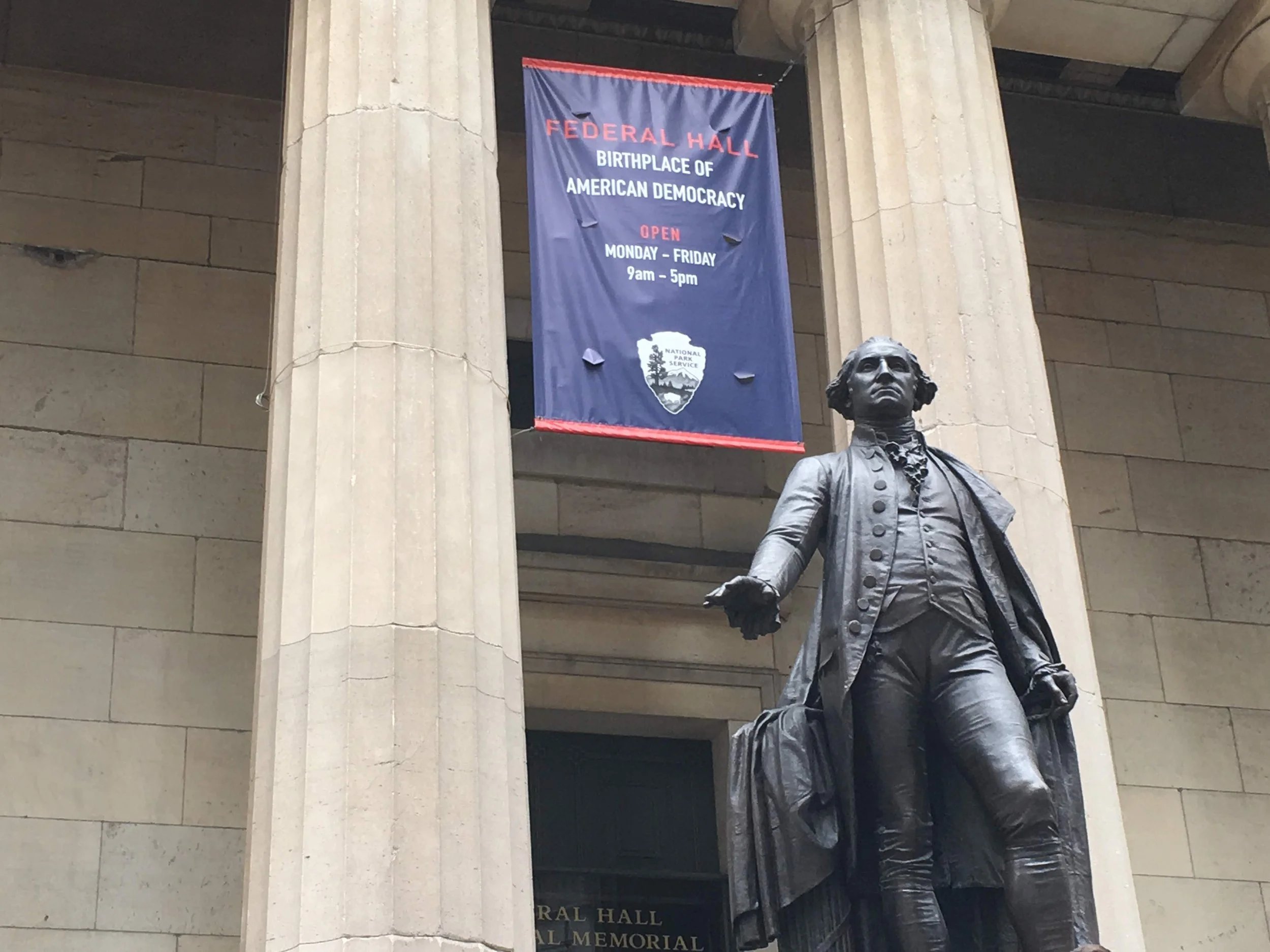
Walk two minutes east to 26 Wall Street and stop in front of the building with the Greek Revival columns and the statue of Washington on the steps. The current structure dates to 1842 — it was once a federal customs house, built on the site of the original Federal Hall, where the United States first functioned as a national government. This is where Washington took the first presidential oath of office on April 30, 1789 (the statue on the steps is positioned approximately where he stood), where the first U.S. Congress met, and where the Bill of Rights was drafted, debated, and proposed.
Federal Hall is operated by the National Park Service and charges no admission. The interior is modest — a domed rotunda, compact exhibits on the founding era, a marker indicating the inauguration site — and you can see it thoroughly in 30 minutes.
Beyond Manhattan
The outer boroughs hold Revolutionary sites that are less visited, less curated, and often more moving. Each of the following can be reached by subway or ferry.
Conference House, Staten Island: Where the Patriots Refused to Surrender
Accessible by free ferry from Whitehall Terminal, adjacent to Battery Park. Plan for a half-day.
One of the most dramatic episodes of the entire New York campaign happened on Staten Island, in September 1776, in a stone manor house overlooking the Arthur Kill.
The setup: The British had just crushed Washington’s army at the Battle of Long Island. New York was effectively lost. Lord Howe, commander of British forces in North America, believed the Americans might now be willing to negotiate — and requested a peace conference. Congress sent Benjamin Franklin of Pennsylvania, John Adams of Massachusetts, and Edward Rutledge of South Carolina. They met Howe at the Conference House on September 11, 1776, in the only formal peace negotiation of the Revolutionary War.
It lasted only three hours. General Howe’s terms required the Americans to renounce independence. Franklin and Adams refused. They sailed back to Philadelphia, and the war continued for seven more years.
The house itself is a 1680 manor, built by a British sea captain, set on a bluff above the water with views that haven’t changed much in 250 years. The Conference House Association operates it as a museum, with period rooms, interpretive exhibits, and guided tours that give the negotiation the dramatic weight it deserves. Ask about the room Franklin and Adams shared on their visit, and their disagreement over whether to sleep with the window open (as Franklin preferred) or closed (as Adams insisted).
Getting to the Conference House is part of the fun. Take the Staten Island Ferry from Manhattan’s Whitehall Terminal, adjacent to Battery Park — free, with views of the harbor and lower Manhattan skyline that are worth the trip all by themselves. From the St. George Ferry Terminal, the Conference House (7455 Hylan Avenue, Staten Island) is roughly 45 minutes by bus or rideshare. Plan for a half-day.
Old Stone House, Brooklyn: Where Maryland Soldiers Held the Line
From Manhattan, take a Brooklyn-bound F or G train to Fourth Avenue/Ninth Street and walk five minutes to Washington Park, a quiet residential square at Fourth Street and Eighth Avenue in Park Slope where children play on a lawn that was, on the morning of August 27, 1776, one of the bloodiest patches of ground in the entire war.
The Battle of Long Island — the largest battle of the Revolution, and the first major engagement after independence was declared — was effectively decided here. Washington’s army was outflanked and overwhelmed by British and Hessian forces. The retreat should have ended in total destruction. But it didn’t, largely because approximately 400 Maryland soldiers chose to stand and fight a rearguard action at the Old Stone House, charging a vastly superior British force six times to buy Washington’s army time to escape.
Most of them died.
Washington watched from his position across the Gowanus Creek and said, “Good God, what brave fellows I must this day lose.”
The Old Stone House in Brooklyn (336 Third Street) now operates as a small museum at street level, with exhibits on the battle and its participants. The house itself is modest, but what it represents is the hinge on which the entire American experiment turned. If those Maryland soldiers hadn’t given their lives to hold the line here, Washington’s army would have been captured or destroyed in August 1776, just weeks after the signing of the Declaration of Independence.
While You’re Here, See “The Occupied City”
At the Museum of the City of New York, “The Occupied City: New York and the American Revolution” is the most ambitious exhibition the America 250 anniversary has yet produced in New York. Seven thousand square feet of immersive environments — a recreated tavern, a Loyalist print shop, a walk-through Canvas Town — trace the city’s role from the first stirrings of rebellion in 1763 to its emergence as the nation’s first capital.
The exhibition’s particular achievement is its insistence on the full cast: not just Washington and the founders, but the revolutionaries, loyalists, Black New Yorkers, women, and Native peoples whose choices and sacrifices shaped the outcome. It presents the Revolution as a contested, lived urban story.
If you’re visiting New York in 2026, this exhibition is the essential companion to everything we’ve shared in this guide. Plan a separate visit — allow two hours.